Choosing a private community platform is primarily a decision about data ownership, search and member experience, not about feature checklists. The candidate set is well established: Slack and Discord, built for workplace chat and gaming respectively, against Circle and its class of purpose-built community platforms. Scale is not the differentiator — Discord says it counted more than 200 million monthly active users as of 2024 — fit with member habits and migration risk is.
What Kind of Decision Is Platform Selection, Really?
It is a bet on where members already spend attention, wrapped in a data-model commitment. The brutal constraint is switching costs: communities that consolidate years of answers and relationships inside one platform rarely migrate successfully, because message archives, member reputations and search history do not transfer cleanly. The decision deserves the same rigor as a CRM choice, and gets it far less often.
Selection also allocates power. On chat-first platforms, the most active members set the culture and the archive belongs to the platform operator. On purpose-built community platforms, the operator programs structure — spaces, courses, events — and owns more of the member relationship. Neither is better universally; they reward different community designs and different staffing models.
Where Do Chat Platforms Fit Best?
Slack and Discord fit communities that live on synchronous conversation: practitioner groups, developer communities, cohorts in progress. Discord's free tier is generous — unlimited message history at no cost — which is why it dominates budget-constrained and hobbyist communities. Slack's free tier historically limits message history, which pushes serious Slack communities onto paid plans, where per-seat pricing punishes large open memberships.
The shared weakness is archival value. Chat streams bury answers within days; knowledge compounds poorly unless someone builds a companion wiki or a searchable digest. Chat platforms also demand high moderation coverage, because real-time spaces generate real-time conflict.
Where Do Purpose-Built Platforms Fit Best?
Circle and its category peers — often described as Circle-like platforms combining forums, events and courses in one member hub — fit communities organized around structured programming: paid memberships, professional associations, accelerator cohorts. Discussions are threaded and durable, events sit natively next to conversations, and member profiles carry persistent identity rather than chat handles.
The trade-offs are cost and gravity. Purpose-built platforms charge real subscription fees, scale linearly with members or features, and are usually another destination members must be convinced to visit. Chat platforms ride habits people already have; destination platforms must earn the visit repeatedly. A community whose members open Discord nightly for other reasons gets membership almost free; a destination platform must create its own pull through programming.
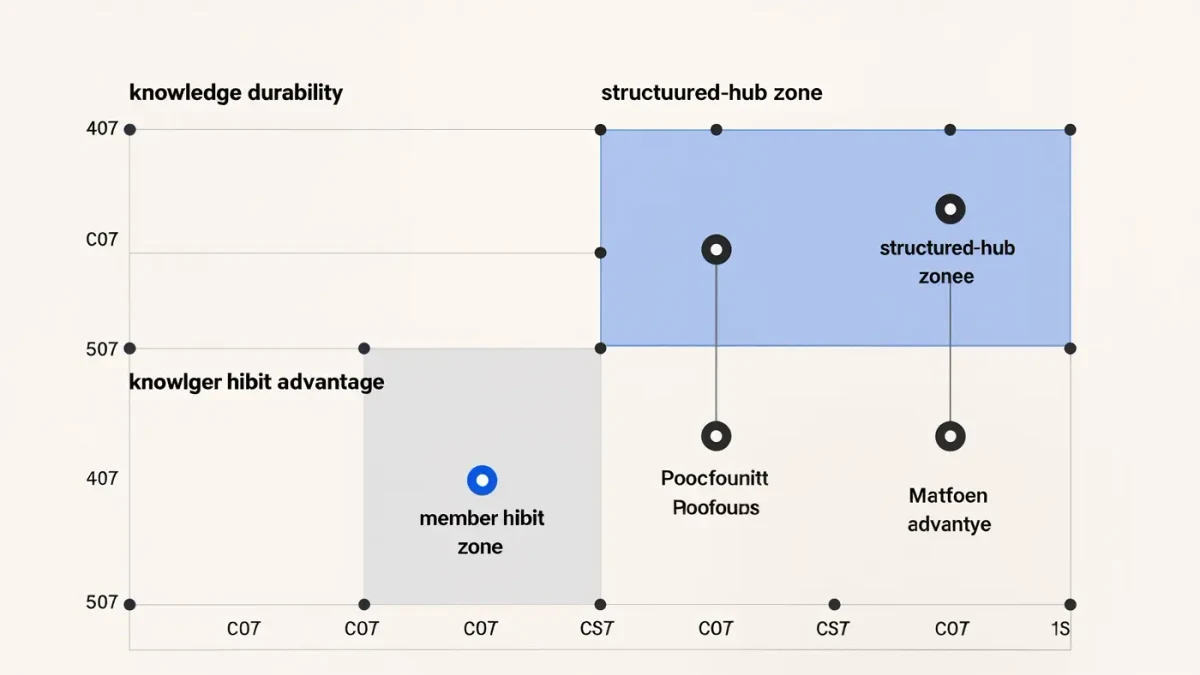
| Criterion | Slack | Discord | Circle-Like |
|---|---|---|---|
| Core model | Workspace chat | Server chat + voice | Forum + events + courses |
| Knowledge durability | Weak without tools | Weak without tools | Strong, threaded |
| Cost at scale | High, per-seat | Low; free history | Subscription, mid |
| Member habit advantage | Workday users | Consumer, younger | None — must earn visits |
| Data export | Limited formats | Limited formats | Often structured |
| Best fit | B2B practitioner | Dev, creator, hobby | Paid, programmed |
What Criteria Should Actually Decide the Choice?
Six criteria separate durable decisions from demo-driven ones. Weight them against the community's actual design, not the vendor's marketing.
- Member habit fit — where the target members already spend daily attention.
- Knowledge model — whether answers must stay findable for years, or only for days.
- Total cost at realistic scale, including moderation tooling and paid tiers in three years.
- Data ownership and export — what can leave, in what format, with what member identity.
- Programming surface — native events, courses, gating, and integration with the organization's stack.
- Governance tooling — roles, permissions, moderation queues and audit logs.
The export question is the one vendors deflect. Sales demos cover onboarding beautifully and export formats never. Teams should demand a test export during evaluation and attempt a restore into a neutral system, because the honest answer about migration arrives only when it is attempted.
How Do You Run a Selection Process Without Regret?
Run it as a short empirical trial, not a procurement review. Recruit 20 to 30 representative members, stand up the two finalist platforms with equivalent structure, and run each for 30 days with the same programming. Measure activation, week-four retention and the qualitative answer to one question: would the member be disappointed if the community closed the other option?
Two failure patterns are worth naming. Demo capture — choosing on vendor demos and impressive feature lists — ignores that most features go unused; communities use perhaps a tenth of available surface. And founder preference, where the platform the team personally likes overrides the platform members actually visit. The trial design neutralizes both by making member behavior, not opinion, the deciding evidence.
Can a Community Run Across Multiple Platforms?
Yes, but only with one canonical home. Multi-platform operation — a Discord for chat plus a Circle for courses plus public social channels — works when each surface has a distinct function and one system holds identity and the durable record. Without a single member spine, measurement collapses, recognition fragments, and moderators burn out duplicating work across surfaces.
The common evolution is consolidation rather than expansion: organizations that started on chat platforms frequently add a structured layer once the archive's value becomes obvious, and organizations on destination platforms frequently add a chat surface because members ask for real-time contact. The architecture question — where does identity live, where does knowledge live — stays stable even as surfaces change, which is why answering it correctly at selection time pays for years.
How Should Migration Risk Shape the Decision?
Migration risk is the criterion teams forget until it is too late. Communities consolidate identity, relationships and years of answers inside their platform, and moving later is expensive and lossy: message archives export in limited formats, member reputations do not transfer, and search equity built inside the platform stays behind. The realistic expectation is that the choice made at selection will hold for three to five years minimum, which raises the stakes of every criterion above.
Migration risk argues for two behaviors during selection. First, test the exit before buying the entrance: demand a full data export during evaluation and attempt to restore it into a neutral system, so the difficulty is known rather than assumed. Second, structure the community so knowledge accumulates in portable forms where possible — a public knowledge base or wiki that mirrors high-value answers, hosted separately from the conversation layer.
Some migrations are nevertheless necessary — pricing shocks, ownership changes, safety failures. The defensible pattern when one arrives is a staged transition: open the new space while the old one stays read-only for a defined archive period, run both briefly with clear signage, and move the rituals — the weekly events and recurring formats — wholesale, because members follow rituals more reliably than they follow announcements. Communities that attempt a big-bang move typically lose a large share of the silent middle, the members who never felt strongly enough to migrate but who constituted most of the value.