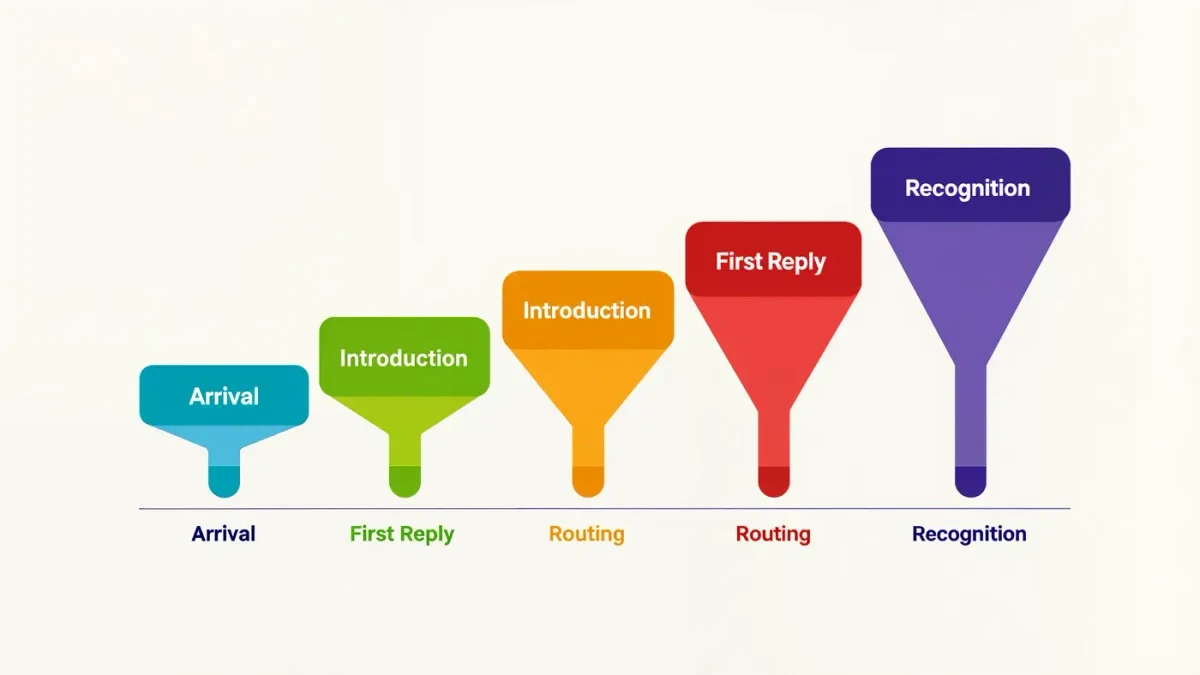
Member onboarding determines retention in the first seven days: the experiences that matter are a fast first post, a fast first reply from a human, and early recognition — not welcome sequences or feature tours. The structural challenge is lurker gravity: Jakob Nielsen's 90-9-1 research (2006) found roughly 90 percent of online group members never contribute, so onboarding is essentially the campaign to move new members into the contributing tiers before passive habits set in.
Why Does the First Week Decide Everything?
Contribution habits form or fail within days. A member whose first post receives a reply within hours begins a participation identity; a member whose first post sits unanswered for a week concludes the community is not for them and rarely tests it again. Practitioner experience across community platforms is consistent: time-to-first-contribution and time-to-first-response are the two strongest levers teams control, and both are measured in hours, not weeks.
The first week is also when expectations get set. Communities that onboard through a welcome ritual — an introduction prompt, a starter question matched to interest, a small act of contribution — establish that participation is normal. Communities that onboard through orientation content establish that lurking is normal. Both patterns compound; only one of them builds a community.
What Does a High-Converting First Experience Look Like?
The first session should accomplish three things: lower the social cost of a first post, route the member to one relevant conversation, and produce one human interaction. Everything else — profile completion tours, feature education, policy reading — can wait. Friction added before the first interaction is friction that subtracts members.
- Arrival: a single clear welcome with one prompt, not a menu of options.
- Introduction: a low-effort first post format — a template question, not an open essay.
- Response: a guaranteed human reply within hours, from staff or an ambassador.
- Routing: one channel or thread matched to the member's stated interest.
- Recognition: the first contribution acknowledged — a reaction, a follow-up question.
The guaranteed-reply stage is the design commitment most teams refuse to make and the one with the highest return. It is staffable: at typical intake volumes, a rotation of staff and ambassadors can answer every introduction within hours. Where volume makes that impossible, the honest fix is throttling intake — cohorts of new members — rather than letting first posts sink.
Which Activation Metric Should Teams Track?
One: the share of new members making a qualifying contribution within seven days of joining. That single number captures the onboarding funnel's outcome, is comparable across cohorts, and diagnoses cleanly — if activation drops, the cause is almost always reply latency or a broken arrival prompt, and both are fixable within a week.
Supporting metrics add diagnosis without adding dashboards: median time-to-first-contribution, median time-to-first-response, week-four retention of activated versus non-activated members. The last comparison usually produces the internal argument-ender — activated members retaining at multiples of non-activated members — which funds the staffing that onboarding requires.
How Do Welcome Rituals Work at Different Scales?
At small scale, personal welcome is the ritual: a moderator greets each new member by name, asks one question, and connects them to one relevant member. Up to a few hundred monthly joiners, this remains feasible with a small team. Beyond that, the ritual must be systematized without being automated into noise — templated structure with human follow-through, ambassador rotations covering introductions, and interest-matched routing replacing individual matchmaking.
| Scale (monthly joins) | Welcome Mechanism | Staffing Pattern |
|---|---|---|
| Under 100 | Personal moderator welcome | Community team |
| 100-500 | Template prompt + human reply | Team + ambassadors |
| 500+ | Cohort intake + ambassador rotation | Ambassadors with staff oversight |
The failure mode at scale is automated welcome that mimics personal attention — greeting bots, bulk mentions — which members recognize immediately and read as indifference with extra steps. Systemization should make human response cheaper, not fake it.
What Role Do Existing Members Play in Onboarding?
In healthy communities, existing members do most onboarding: answering introductions, tagging newcomers into relevant threads, modeling norms. This is a cultural property that leadership can cultivate — by publicly crediting members who welcome others, by making welcome part of ambassador role descriptions, and by staff deliberately not answering every question so that members learn the space belongs to them.
The counterintuitive staff behavior matters: teams that answer everything fast create dependency and cap the community's member-to-member character. The better pattern is staff seeding — connecting the newcomer's question to a member who can answer, then stepping back. It takes longer per interaction and builds the connectedness that makes retention structural rather than staff-funded.
How Do You Re-Engage Members Who Slipped Into Lurking?
Some lurker conversion is realistic; total conversion is neither realistic nor necessary — a large reading base is a legitimate audience layer inside a community. Re-engagement works when it is specific: a message referencing a topic the member once engaged with, an invitation to a small format — a poll, a working session — rather than a general exhortation to participate. Generic reactivation broadcasts produce unsubscribes, not posts.
The honest framing for strategy: onboarding is not about converting every member into a contributor. It is about ensuring that everyone who would contribute — the shy expert, the busy practitioner with one good answer a month — does not get filtered out by silence, friction or an arrival experience designed for lurkers. Raise the floor of the first week, and the 9 percent tier grows on its own.
What Common Onboarding Mistakes Should Teams Avoid?
Four mistakes account for most failed onboarding. The menu problem: presenting new members with every channel, event and resource at once, which converts curiosity into overwhelm; the fix is one recommended next step, not a directory. The compliance problem: gating participation behind lengthy orientation, profile completion or policy quizzes; every hour between arrival and first interaction leaks members, and the policy can be affirmed in a checkbox rather than studied as a rite of passage.
The broadcast problem: welcoming new members with an automated announcement to the whole community and nothing else. A hundred strangers saying hello is noise; one relevant member answering the newcomer's introduction is activation. Teams should invert the effort — skip the mass announcement, invest in the single routed introduction.
The disappearance problem: strong week-one energy followed by silence, which teaches members that attention was a launch behavior rather than a community property. Onboarding should taper deliberately — high touch in week one, a check-in at week four, an invitation into a recurring ritual by week six — so the handoff from staff welcome to member relationships is designed rather than assumed. Communities that plan the taper retain the members their first week earned.