Audience is a distribution asset: people who receive what a brand publishes, measured in subscribers, impressions and follower counts. Community is a connection asset: members who interact with each other around a shared purpose, measured in member-to-member activity, contribution rates and retention. The scale of the distinction is visible in Meta's own reporting — more than 1.8 billion people used Facebook Groups monthly as of 2021 — yet follower counts remain the default KPI most teams still report first.
What Actually Separates a Community From an Audience?
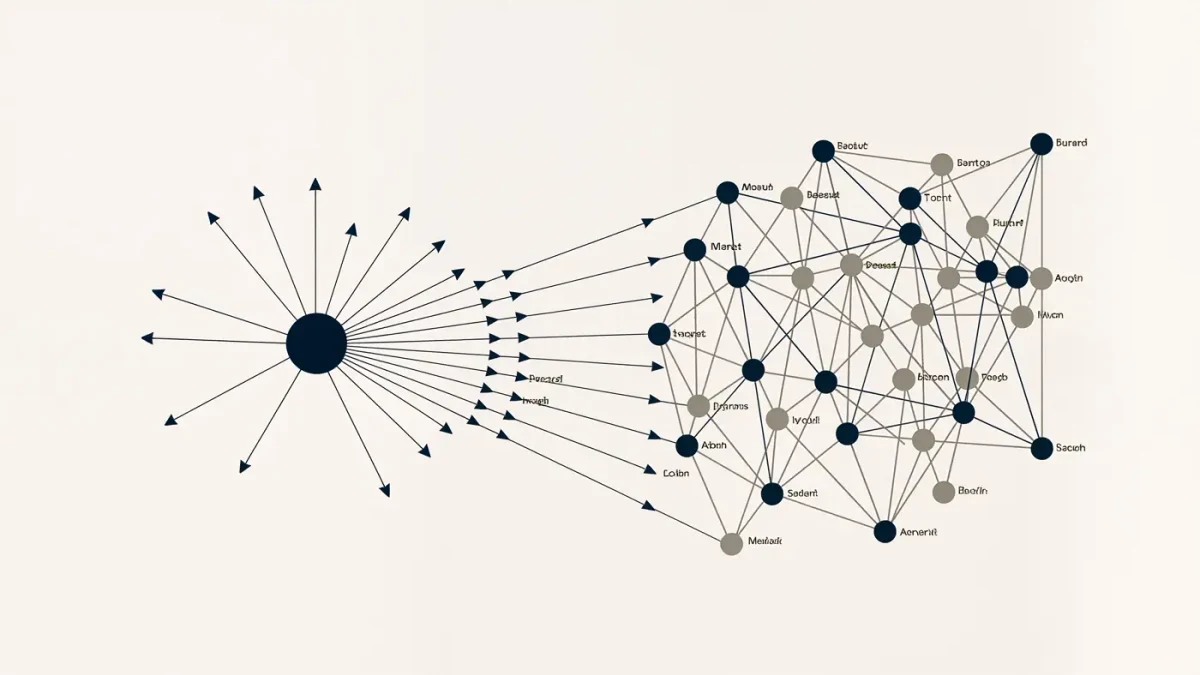
The test is directional: in an audience, communication flows one way, from the brand outward. In a community, a meaningful share of communication flows member to member, and the brand is a host rather than a broadcaster. An audience values the output; a community values each other. That distinction determines cost structure, growth mechanics and every metric worth reporting.
The practical implications are significant. Audiences are rented from platform algorithms and priced through paid reach; communities compound because members recruit, answer and moderate. But audiences scale indefinitely — a broadcast costs the same regardless of viewers — while communities scale with relational limits, since human attention and moderation capacity are finite. A team that measures a community with audience KPIs will optimize toward broadcasting, and the community properties will quietly decay.
Why Follower Count Is the Wrong North Star for Community?
Follower count measures permission to send messages, not relationships. It can rise while the community weakens: inflated by giveaways, follow-loops or paid acquisition, it tells nothing about whether members talk to each other, return, or would notice if the space disappeared. Platforms themselves have deprecated vanity metrics — Instagram hid public like counts starting in 2019 — signaling how weak the correlation is between visible counts and actual engagement quality.
For community purposes, follower count has one legitimate use: as a top-of-funnel capacity number. It estimates how many people could be converted into members. The conversion step — follower to participant — is where community measurement begins, and it is a number most brands never compute because it requires connecting two data systems.
Which Metrics Replace Subscriber Counts for Communities?
Five metrics carry most of the weight: contribution rate (share of members taking a qualifying action in 30 days), member-to-member reply share, cohort retention at 90 days, time-to-first-contribution, and member-initiated events or discussions. Each measures a relationship property rather than a distribution property. None can be inflated by buying reach.
| Dimension | Audience Metric | Community Metric |
|---|---|---|
| Scale | Followers, subscribers | Active members (30-day qualifying action) |
| Engagement | Impressions, views, likes | Member-to-member replies, threads started |
| Loyalty | Repeat view rate | 90-day cohort retention |
| Advocacy | Shares per post | Member-initiated recruitment, referrals |
| Cost | CPM, paid reach | Cost per retained member, moderation hours |
When Does an Audience Become a Community?
The transition is measurable, not philosophical. It happens when member-to-member interactions exceed brand-to-member interactions, and when removing the brand from conversations for a week does not stop them. Teams can run that test directly: schedule a week of host-silence and count the member-initiated threads that survive. The result is usually clarifying, occasionally humbling.
The transition typically follows a sequence:
- broadcasting to an audience with comments enabled;
- recurring commenters recognizing each other by name;
- members answering questions the brand would have answered;
- members starting discussions without a brand prompt;
- members organizing activities, events or subgroups independently.
Stage four is the defensible threshold. At that point the asset behaves like a community economically — it produces content, support and recruitment the brand no longer pays for directly — and measurement should switch over fully.
How Do Business Outcomes Differ Between the Two?
Audience outcomes are media outcomes: reach, frequency, brand recall, attributed conversions. Community outcomes are retention and advocacy outcomes: lower support cost, higher customer lifetime value, organic acquisition through member referral. Harvard Business Review reporting on Bain research (2014) famously linked a 5 percent improvement in customer retention to profit increases of 25 to 95 percent — a mechanism that runs through community relationships, not through reach.
The honest caveat: attribution is genuinely harder for community. A member who answers 200 questions may generate measurable support savings, but word-of-mouth referral value resists precise modeling. Teams should resist inventing precise ROI figures; defensible proxies — deflected support tickets, member referral share, retention deltas between members and comparable non-members — are more credible than a vendor-style total value number.
What Tools and Structures Support Community Measurement?
Measurement needs three components: an event source (platform analytics or an export), a member identity spine that stitches activity across channels, and a cohort model. Tools matter less than the spine. Many communities run across a public social audience and a private space simultaneously, and without a unified member table the funnel from audience to community cannot be computed at all.
Structurally, the community function should own a monthly scorecard with contribution rate, member-to-member share and cohort retention alongside whatever audience metrics the media team reports. Keeping the two scorecards separate prevents the most common failure mode: averaging away the community signal inside a combined engagement number that broadcasting always wins.
Should Brands Ever Choose Between Audience and Community?
Most organizations need both, sequenced deliberately. The audience is the acquisition engine; the community is the retention engine. The failure cases are predictable in both directions: all-audience brands pay perpetually rising reach costs with no compounding, while all-community brands cap their growth at whatever the existing member network can recruit. The deliberate pattern is audience-to-community conversion tracked as a funnel metric.
The choice that matters is budget allocation. Community requires staffing — moderation, programming, member care — that does not scale to zero the way scheduled posting does. Organizations unwilling to fund that staffing are better served by an audience strategy executed well than a community strategy executed nominally, because a neglected community is worse than no community: it is a public record of unanswered questions.
What Does the Funnel From Audience to Community Look Like?
The audience-to-community funnel has four measurable stages: reached (people who saw brand content), subscribed (followers who opted in), joined (subscribers who entered the community space) and activated (joiners who contributed within a set window). Most organizations measure the first two stages obsessively and the last two not at all, which is why community growth feels mysterious — the unmeasured stages are where it happens.
Each transition has a distinct lever. Reached-to-subscribed responds to content quality and distribution spend — classic media work. Subscribed-to-joined responds to invitation design: how clearly the community's purpose is stated, how visible the private space is, and whether joining carries a concrete promised benefit rather than a generic belonging claim. Joined-to-activated responds to onboarding mechanics — first post formats, guaranteed first replies, interest-based routing — and it is the stage with the steepest drop in most funnels.
Funnel math changes budget conversations. If joined-to-activated runs at 5 percent, doubling activation does more for the community than doubling ad spend on reached. Teams that compute the full funnel typically find the cheapest growth sitting in stages they had never instrumented, and the expensive stages — paid reach — already optimized to diminishing returns. The funnel does not need new tools; it needs the member identity spine that connects follower data to community activity data, which most organizations can assemble from existing exports.