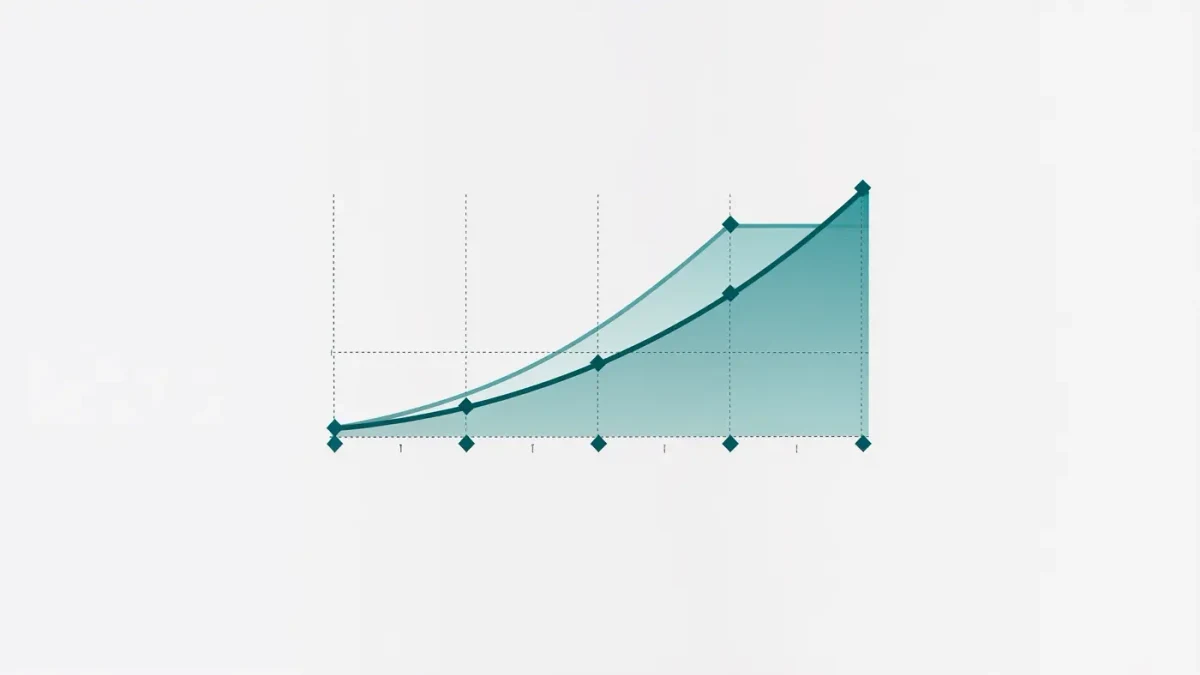
The evidence on posting frequency does not support a single number: analyses of large post datasets, such as the recurring studies published by scheduling vendors analyzing millions of posts (2023-2025), consistently show per-post engagement declining as monthly posting volume rises, while total engagement rises more slowly — a pattern of diminishing returns, not a cliff. The practical conclusion, visible across both vendor research and platform creator guidance, is that cadence is a constraint problem: the right frequency is the most posts a team can sustain at consistent quality before its audience's per-post response visibly decays. Any advice more specific than that is extrapolated from somebody else's account.
What Does the Evidence Actually Consist Of?
Three bodies of evidence inform cadence decisions, each with different weaknesses. Vendor studies — Buffer, Hootsuite, Sprout Social and peers — analyze posts created through their tools and report engagement by posting-volume bands; they are large but non-random samples skewed toward managed business accounts. Platform guidance — Instagram's and TikTok's published tips for creators — offers ranges so wide (from a few posts weekly to multiple posts daily on TikTok) that it functionally says "quality over quantity," which is a slogan, not a parameter. And internal A/B or before-after tests on individual accounts are the most relevant evidence but the scarcest, because most teams never run them.
The one finding that recurs across all three bodies: frequency effects are second-order. Content quality, format and creator dominate outcomes at every cadence level. Cadence decides how much quality gets shown, not whether quality works.
What Are the Working Frequency Ranges by Platform?
As starting hypotheses to test — not rules — practitioner consensus and platform guidance converge roughly here.
| Platform | Common starting range | Constraint that binds |
|---|---|---|
| 3-5 feed posts per week | Production quality ceiling | |
| TikTok | 3-7 posts per week or more | Native format volume tolerance |
| 2-5 posts per week | Executive time and POV supply | |
| X | 1-3 posts per day | Feed half-life measured in hours |
| YouTube | 1 video per week or less | Production cost per asset |
| Facebook Pages | 3-5 posts per week | Distribution caps for pages |
The ranges differ because the underlying mechanics differ: X decays fastest, so volume buys reach; YouTube decays slowest, so each asset must justify its cost. Copying a cadence across platforms ignores why the cadence exists.
Does Posting More Cannibalize Existing Posts?
Sometimes, and the mechanism matters more than the label. On ranked feeds, a new post competes with the previous one for the same early engagement window; posting again before the prior post finishes distributing splits attention signals, which practitioners observe as both posts underperforming. On high-tempo surfaces like X, overlap barely matters because each post's life is short. The honest answer is that cannibalization is account-specific and observable: if median reach per post falls materially after a cadence increase, volume is competing with itself. That signal — not a doctrine — should set the ceiling.
What Happens When Teams Over-Post?
The damage runs through two channels. Audiences respond with soft opt-outs — mutes, unfollows, skips — that reduce reach per post while the follower count hides the decay; the account looks healthy while distribution quietly shrinks. And content quality erodes, because filling a calendar at a volume the team cannot sustain produces filler, and filler teaches the audience to scroll past. Platform ranking learns the same lesson: posts that consistently fail to earn engagement train the distribution system to expect less from the account. Recovery from a quality-driven reach decline takes longer than the decline took.
How Can a Team Find Its Own Optimal Frequency?
A cadence test is cheap and takes one quarter.
1. Baseline the current cadence: median reach and reach-based engagement per post over the trailing 60-90 days.
2. Hold content mix constant — same formats, same themes — because changing cadence and content simultaneously destroys the comparison.
3. Step the cadence up or down by 25-50 percent, not by multiples, and hold for at least four weeks.
4. Watch median per-post reach and follower actions: muted-equivalent signals appear as falling reach with flat followers.
5. Stop at the step where per-post medians decay; the previous step is the working ceiling.
6. Re-test annually or after major audience growth, because the ceiling moves with audience size and platform ranking changes.
Does the Right Frequency Change With Account Size?
Yes, in a predictable direction. Small accounts benefit from volume because every post is a lottery ticket for distribution: with a small follower base, discovery surfaces do most of the reaching, and more attempts mean more chances at a breakout. Large accounts hit the opposite constraint — the follower base is the distribution, and each additional post lands on an audience that has already seen the brand several times in the same week, so per-post decay arrives sooner. This is why the same cadence advice cannot travel between a 5,000-follower account and a 500,000-follower one, and why benchmark tables that ignore account size mislead on cadence specifically.
The test procedure above absorbs this automatically: the decay signal appears at different volumes for different accounts, and the test finds the individual ceiling wherever it sits.
What About Consistency Versus Volume?
Consistency wins where the evidence can distinguish them. Accounts posting on a stable rhythm outperform erratic accounts posting the same monthly volume, because distribution systems and audiences both reward predictability — feeds spread posts over time, and audiences learn when to expect content. The operational version of this finding: a sustainable cadence held for a year beats an ambitious cadence abandoned in month three. Teams should set frequency at the level they can staff on their worst month, not their best week.
How Should Cadence Decisions Be Governed?
Cadence should be a written hypothesis with an owner, a review date and a kill condition — the metric level at which the current cadence is judged harmful. Quarterly review against per-post medians and follower actions; revision when audience size shifts materially; documentation of what was tried and what happened, so the organization stops relitigating cadence every time a new hire brings folklore from a previous employer. The teams that treat frequency as a testable variable stop having the argument permanently, which is worth more than any specific number the argument would have produced.
The final calibration is budgetary. Every cadence increase is a production commitment: more briefing, more creative, more review capacity. A team that models cadence decisions as content-investment decisions — what does one more post per week cost, and what did the last increase return per post — will usually discover its true ceiling sits below the volume the calendar could physically hold and above the timid schedule caution recommends. The evidence does not hand anyone a number, but it hands them a method, and the method converges.