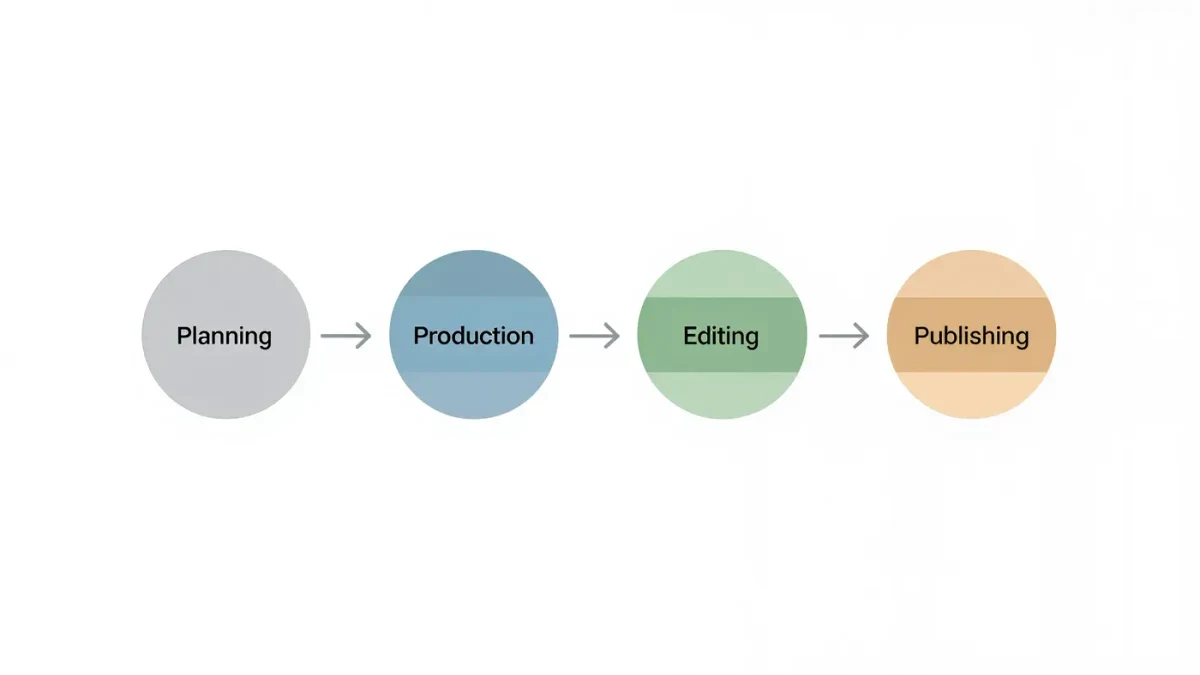
A short-form video workflow is a weekly production loop with four stages — planning, capture, post-production and platform-native publishing — and the teams that publish reliably treat it as manufacturing rather than art. Platform creator documentation from TikTok, Instagram and YouTube (2025) rewards vertical video under roughly three minutes with dedicated surfaces, but none of it rewards irregular output. The workflow below assumes one or two batched shoot days per month producing eight to sixteen assets, a cadence most mid-size brand teams can staff.
Why Does Planning Come Before Any Camera Work?
Planning converts the content pillar calendar into shot lists, and it is the only stage where cost overruns are cheap to fix. A usable weekly planning block produces three artifacts: a hook table with the first two seconds written for every clip, a shot list grouped by location and setup, and a repurposing map that names the derivative cuts each master asset must yield. Writing hooks before shooting matters because the opening line determines whether the rest of the video is watched, and reshooting an opening in post is impossible. The planning stage should also fix one constraint per clip — duration target, aspect ratio, caption strategy — so the edit session inherits decisions instead of inventing them.
How Do Batch Shoot Days Actually Run?
Batching collapses setup overhead: lighting, audio and talent availability cost about the same whether the team shoots one clip or ten. A workable shoot-day sequence looks like this:
- Pre-light the first setup and lock exposure and white balance manually so every clip matches.
- Record a five-second slate — clip code, pillar, hook version — at the head of every take for logging.
- Shoot each script in two to three hook variants, since hook performance is the highest-variance element.
- Capture cutaways and b-roll at the end of each setup while the lighting is still standing.
- Record audio to a separate microphone track, never camera-only, and back up cards before leaving the location.
Two hook variants per script roughly doubles the number of testable openings from a single day of talent time, which is the cheapest A/B capacity a video team can buy.
What Belongs In The Edit System?
The edit stage should run on templates, not on per-project invention. A functioning system keeps a project file template per pillar with pre-built caption styles, safe-area guides for each platform and a standard export preset per destination. Editors work in a fixed order: assembly against the script, pacing pass at the cut level, captions burned or styled per platform norm, sound design, then a compliance read for claims and disclosures. The FTC's updated endorsement guides (2023) put disclosure responsibility on the brand as well as the creator, so a disclosure check belongs in the edit checklist rather than in legal's inbox afterward. Versioning discipline is unglamorous and decisive: one master file per clip code, derivatives named by platform and aspect, and nothing exported outside the preset list.
How Should Publishing Differ By Platform?
The same master clip should ship as three genuinely different uploads, because each platform's player, caption norms and search behave differently.
| Platform | Native norm | Publishing requirement |
|---|---|---|
| TikTok | 9:16, hook under 2 seconds | Upload in-app, trending audio, keyword caption |
| Instagram Reels | 9:16, cover frame chosen | Cover image, safe-area check, no burned TikTok watermark |
| YouTube Shorts | 9:16 up to 3 minutes | Keyword title, since Shorts surface in YouTube search |
| 9:16 or 1:1, sound-off first | Native upload, subtitles mandatory, business framing |
Cross-posting a watermarked file is the most common self-inflicted distribution penalty; Instagram has publicly stated since 2021 that watermarked Reels uploads are deprioritized, and the cheapest workflow fix is exporting clean masters for every destination.
What Does Post-Mortem Data Feed Back Into Planning?
The loop closes when publish-week data changes next month's shot list. Review three metrics per clip — average watch percentage, hook retention at three seconds and saves or shares — and file the result against the hook table from planning. Watch percentage diagnoses pacing; three-second retention diagnoses the hook; saves diagnose whether the content was useful rather than merely watchable. Feed the two best hook variants into the next brief as patterns, and retire formats whose median watch percentage decays across three consecutive cycles. Keep the review to thirty minutes weekly with the editor present, because the fastest workflow improvements come from editors flagging friction the strategist never sees.
Where Do Short-Form Workflows Usually Break?
Breakage clusters at handoffs. Planning hands the edit a script without shot lists; the edit hands publishing a master without platform derivatives; publishing hands analytics nothing tagged, so the post-mortem cannot attribute results to format or pillar. The fixes are structural: the shot list is a required input to any shoot, the export preset list is closed, and every published asset carries its clip code into the analytics tool. Teams that publish inconsistently almost never have a talent problem — they have an undefined handoff problem that one written checklist per stage resolves.
What Equipment And Staffing Level Does The Workflow Assume?
The production values question is mostly a distribution question, because platforms compress all uploads to similar specifications and viewers watch on phone screens. A credible brand baseline is a modern smartphone or entry mirrorless camera, a clip-on or lavalier microphone — weak audio degrades a video faster than soft image does — one soft key light, and a tripod. That kit covers talking-head pillar content, which is the bulk of most brand calendars. Staffing compresses the same stages rather than eliminating them: one person can run the loop up to about two posts per week, while a three-person cell — strategist, shooter-editor, publisher-analyst — sustains daily output across two platforms. What does not scale is skipping stages, because a workflow without a planning block produces footage nobody scheduled, and a workflow without a post-mortem produces the same footage forever. Budget review time as seriously as shoot time; an unplanned shoot day is the most expensive way to acquire unusable assets.
How Does Creator And UGC Footage Fit The Same Workflow?
Creator-supplied clips enter the pipeline at the edit stage, but they still need the same spine: a brief with a hook requirement, a disclosure check under the FTC endorsement guides (2023), and a platform-native export. The recurring failure in creator pipelines is brief omission — brands ship a mood board where a shot list belongs, then discover the footage cannot be cut into the calendar's formats. A one-page creator brief specifying duration, orientation, hook line, mandatory on-camera disclosure and delivery format brings creator content into the same weekly loop as in-house production, and lets the same post-mortem data judge both sources by identical standards. Tag creator assets with their origin in analytics, because their cost structure differs from in-house production even when their formats are identical.