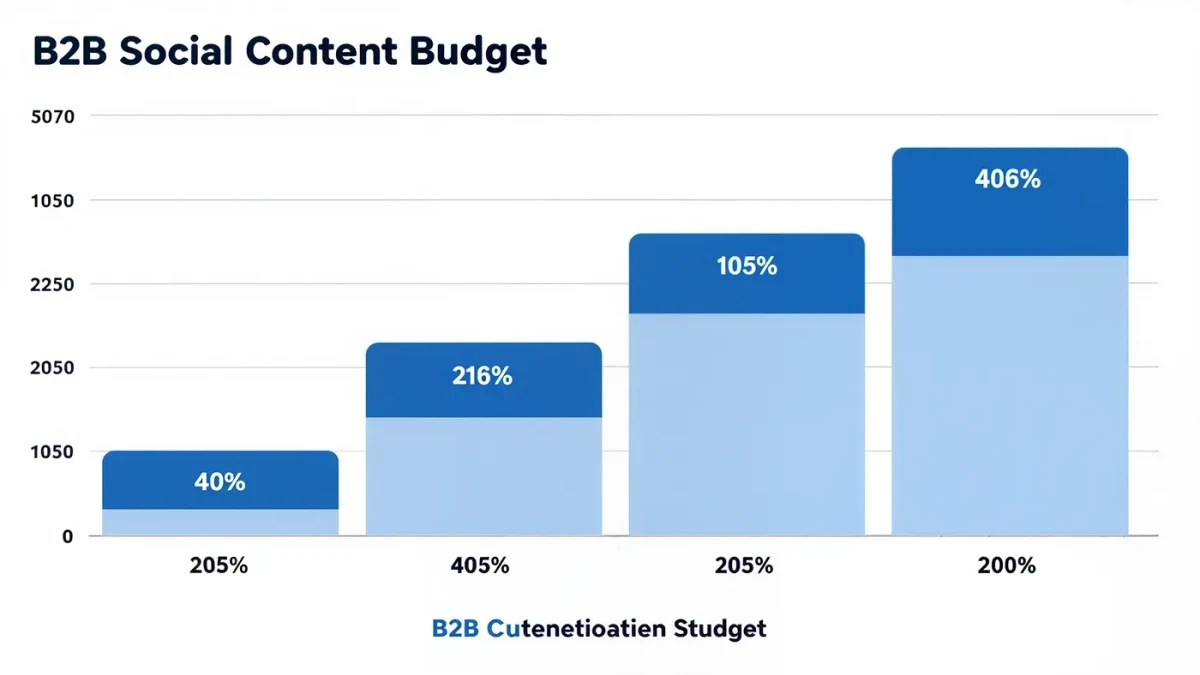
B2B social budget allocation is a portfolio problem, not a channel-choice problem: the working method is to split spend across three to four channels weighted by where the buying committee actually spends attention, reserve production capacity by tier, and rebalance quarterly on pipeline evidence rather than engagement. LinkedIn remains the default anchor for most B2B programs, and its own advertiser documentation (2025) positions it as the professional network where B2B buyers are reachable — a claim vendors obviously benefit from, which is exactly why allocation should be tested rather than inherited. A defensible starting split for a mid-market B2B team is 40 to 50 percent of content budget on the primary channel, 20 to 30 percent on one to two secondary channels, and 15 to 20 percent on experimentation.
What Are You Actually Allocating: Money, Time Or Capacity?
B2B teams chronically confuse three budgets. Cash budget covers media, tools, creator fees and freelance production. Team hours are the scarcest resource and the one finance dashboards never show. Approval capacity — legal, product and executive review bandwidth — throttles claims-heavy B2B content more than production does, because comparative claims, customer names and data citations all gate through SMEs. A realistic allocation model prices all three: assign each channel a cash line, an estimated weekly team-hours figure and an approval-tier classification. Channels that look cheap in cash, like organic LinkedIn text posts, are frequently expensive in SME hours, and mispricing that trade is the most common allocation error in B2B.
How Do Channels Earn Budget In A B2B Mix?
Channels should be treated as a portfolio with distinct jobs, and each allocation should name its job explicitly.
| Channel | Portfolio job | Typical share band |
|---|---|---|
| Demand capture, buying-committee reach | 40-50% | |
| YouTube | Depth: demos, webinars, search shelf life | 20-30% |
| One experimental channel | Option value: short-form, communities, emerging platforms | 15-20% |
| Employee advocacy enablement | Amplification of the above | 5-10% |
The bands are starting positions to be rebalanced, not destinations. The experimental line deserves defense: without it, budgets drift toward incumbent channels on legacy evidence, and by the time a channel is obviously working, the cheap learning window has closed.
How Should Budget Split By Format Within A Channel?
Within each channel, split production budget by format tier rather than evenly across posts. A workable three-tier model: anchor assets — flagship video series, original research, webinars — take roughly half of production spend; pillar content — carousels, text analyses, short clips — takes about a third; and topical reactive posts take the remainder, produced cheaply with templates. Anchor assets are what earn follows and citations; pillar content is what fills the calendar; reactive content is what keeps the account sounding present. The precise ratio matters less than the existence of tiers: even allocation produces feeds where nothing is worth following and everything costs the same to make.
How Do You Rebalance Without Chasing Noise?
Rebalance quarterly on a fixed evidence hierarchy:
- Pipeline attribution and influenced revenue, where tracking exists, ahead of every other signal.
- Qualified audience growth — followers matching the buyer profile — ahead of raw follower counts.
- Depth behaviors: watch time, saves, document downloads, event registrations.
- Engagement only as a tiebreaker, never as the primary allocation criterion.
Move budget in increments of ten points or less per quarter. Dramatic reallocations based on one quarter usually overfit, since B2B sales cycles run months and last quarter's content is often still mid-funnel. Keep the experimental line funded even in bad quarters — it is the cheapest insurance against the portfolio ossifying around one channel's declining economics.
What Wastes B2B Social Budget Most Reliably?
Three patterns absorb spend without return. First, channel proliferation without capacity: five channels at one-fifth quality each, when three at full quality would compound. Second, production values misallocated across tiers — cinematic video for reactive posts and slide screenshots for anchors, inverting where polish pays. Third, measuring the portfolio on engagement while the business funds it for pipeline, which forces the team to optimize for a metric no one will defend at budget review. Every one of these is an allocation error, not an execution error, which is the argument for revisiting the split quarterly with the same seriousness finance applies to any other portfolio.
How Do Paid Amplification And Organic Content Share One Budget?
The cleanest structure separates production budget from amplification budget, then lets evidence move the amplification line. Production funds the assets themselves; amplification funds distribution — boosts, sponsored posts, creator whitelisting — on top of organic reach. The discipline that keeps the pairing honest is an amplification rule: only content that has already demonstrated organic performance earns paid spend, which turns the organic feed into a cheap testing ground and paid into a scaling mechanism rather than a life-support system. The failure pattern to avoid is paying to distribute content that organically failed, which purchases impressions for assets the audience has already voted against. A reasonable starting split for a mid-market program puts the majority of cash into production and a minority into amplification, adjusting quarterly; a program that inverts this — heavy media, thin production — reliably buys reach for content not worth reaching with.
How Does Team Size Change The Allocation?
Allocation ratios assume a certain production capacity, and small teams should tilt toward fewer channels and deeper assets rather than mimicking enterprise spreads. A two- or three-person B2B social team running four channels is usually publishing four shallow feeds; the same team on LinkedIn plus YouTube, with a modest experimental line, can compound authority in the two places B2B buying committees actually spend research time. Enterprise teams face the opposite risk: incumbency, where every channel has an owner whose budget is never revisited because revisiting it costs a political fight. The quarterly rebalance exists for precisely that, and the ten-point movement cap keeps it survivable. Size changes the denominators, not the method — cash, hours and approval capacity, priced together, then rebalanced on the same evidence hierarchy at any scale.
What Triggers An Emergency Rebalance Outside The Quarter?
Quarterly discipline holds except under three triggers. A platform policy shock — a major format change, an API restriction, an advertising category ban — can invalidate an allocation assumption mid-quarter. A competitive event, such as a category competitor suddenly dominating a channel, may justify shifting measurement emphasis even when spend stays put. And an internal shock, typically a product launch or a budget cut, changes the whole portfolio's constraints at once. In each case, run an abbreviated version of the same evidence review rather than reacting by announcement, and document which trigger fired so the portfolio history explains its own discontinuities.