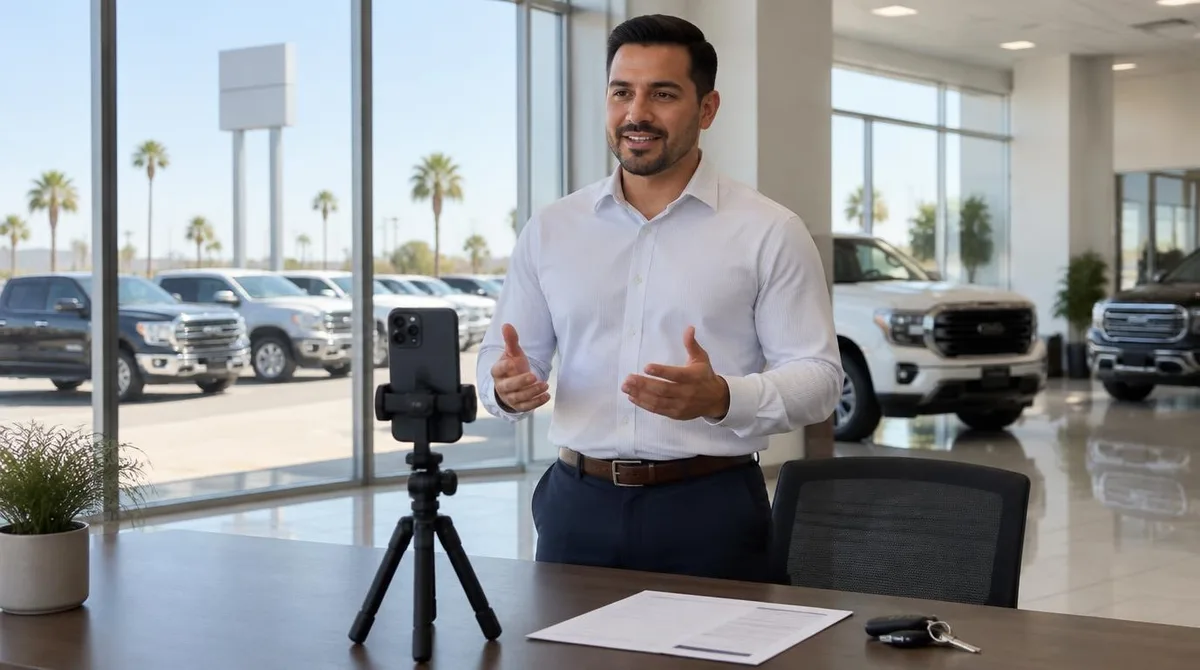
A dealer's social media strategy built on transparency works when two things happen at once: the content shows what buying actually involves, and the pricing shown in the comments holds up when the customer arrives. Payne Edinburg Chrysler Dodge Jeep Ram in Texas runs both halves, and its general manager says the results are measurable: "Adrian the Car Guy" content generates about 5 million to 7 million views and 150 to 180 leads monthly, per CBT News.
The context matters. Stellantis paused its dealer marketing covenant, the policy that aimed to level pricing across stores, and now offers employee pricing across its lineup plus stackable rebates, coupons and select-inventory incentives. That shift puts pricing competition back in dealers' hands. Adrian Gonzalez, the store's general manager, told CBT News his response is to compete on trust, using social channels to build familiarity rather than to shout discounts. Compared to what? Compared to racing to the lowest advertised price, which the paused covenant was meant to stop.
The practical lesson for brand social teams in any category is the sequence, not the car business. Content earns attention, a defined process converts it, and transparency keeps the promise made in the video. Below is how that sequence works at Payne Edinburg, and what a team would need to copy it. The approach also fits a broader shift marketers have tracked since the authenticity wave: the formats that survive hype cycles tend to be the ones showing real operations, a pattern covered in our piece on authenticity formats after BeReal. For related coverage, see Authenticity Formats After BeReal: What Survived the Hype Cycle.
What does a transparency-first social media strategy actually involve?
It involves documenting everyday buying moments instead of performing for the algorithm. Gonzalez advised dealers to prioritize authenticity and turn content into customer engagement. His team skips dances, sketches and trending audio. Instead, it shows shoppers what purchasing a vehicle involves, with a full-time videographer creating content for social platforms and YouTube.
That choice has a staffing cost and a staffing benefit. The cost is a dedicated production role; the benefit, per Gonzalez, is consistency, because a videographer helps dealers publish steadily. The benefit compounds internally too: new salespeople gain recognition quickly, and some customers request employees they have seen in videos. The content is doing two jobs at once, marketing the store and marketing the people in it.
How does the content turn into leads the team can actually work?
Through staffing and a logged process, not through hope. The dealership has an online sales manager who provides video pricing and proposals, plus three salespeople handling social leads. The store receives 20 to 25 inquiries daily. Staff qualify them, log them in the CRM and track them through the sales process.
Three roles carry the load, and each maps to a stage:
- The videographer feeds the top of the funnel with consistent content.
- The online sales manager answers interest with video pricing and proposals, keeping the transparency promise in the reply itself.
- Three salespeople work the social leads, with the CRM recording every step so nothing depends on memory.
The conversion detail worth copying is the medium. Video pricing means the customer sees a person state a number, not a form that promises a callback. In a category where shoppers distrust advertised prices, the format and the message match.
Why do firm out-the-door prices before the visit matter?
Because they remove the main reason buyers hesitate. Customers at Payne Edinburg receive firm out-the-door prices before visiting, which Gonzalez said helps those who live farther away or need to consult family. An out-the-door price is the total cost including fees, stated up front rather than revealed at the desk. This connects to our earlier piece, Text Only Posts — Silent Posting and Text-Only Formats: Who They Reach and When They're Worth It.
This is the transparency mechanism in its purest form. The social content builds familiarity; the pre-visit price converts familiarity into a planned trip. A lead that arrives knowing the number is a different kind of lead than one that arrives to negotiate. The store's 150 to 180 monthly leads are only as valuable as the process behind them, and the firm-price commitment is that process.
What should a marketing team do when pricing policy shifts underneath them?
Plan for the shift, not the specific policy. Gonzalez initially welcomed Stellantis' marketing covenant, believing consistent pricing would encourage customers to choose dealers for trust rather than the lowest advertised price. The automaker then paused the policy. His store stayed on the trust strategy anyway, supported by the new employee pricing, stackable rebates and select-inventory incentives.
The transferable move is to anchor strategy on what a brand controls, its content, its response process and its pricing honesty, rather than on a manufacturer's promotional framework. Policies pause; a videographer, a CRM discipline and a firm-price promise do not. Teams building community around their own people rather than around a platform's promotion calendar will find the shift less disruptive, a distinction our community coverage returns to often.
What would it take to copy this approach?
Four commitments, all drawn from what this store actually does:
- Dedicated production. A full-time videographer, because Gonzalez said a videographer helps dealers publish consistently. Sporadic posting does not build recognition.
- Operational content. Document everyday moments that show what buying involves, and skip dances, sketches and trending audio.
- A response org. An online sales manager providing video pricing and proposals, plus three salespeople handling social leads, with 20 to 25 daily inquiries qualified and logged in the CRM.
- A price promise. Firm out-the-door prices before the visit, so the transparency in the content survives contact with the transaction.
The volume assumptions behind the model are the store's own reported figures: 5 million to 7 million views and 150 to 180 leads monthly, with daily inquiries of 20 to 25. Those are self-reported numbers from one dealership, not an industry benchmark. A team copying the playbook should treat them as an upper illustration, not a forecast, and measure its own baseline before and after.
The evidence here establishes what one store does and what its general manager says it produces. It does not establish that every dealer, or every brand in another category, would see similar lead volume. What it does show is a working mechanism: consistent operational content, staffed follow-up and pre-visit pricing transparency, each reinforcing the others. That mechanism is portable. The specific numbers are not.