The "creator middle class" remains more aspiration than measurement. Goldman Sachs estimated the creator economy at roughly $250 billion in 2023 and projected growth toward $480 billion by 2027, yet the same analysis acknowledged that the market's earnings remain heavily skewed toward a small top tier, and platform payout disclosures since then have reinforced the point: most creators who earn anything at all earn very little, while a durable middle tier exists mainly in specific niches with off-platform revenue.
What data sources exist on creator income?
There is no census of creators, so every income claim rests on one of four sources: platform payout reports, which cover only a platform's own participants; creator-tool vendors like Linktree and Patreon, whose surveys cover their users; investment-bank estimates like Goldman Sachs' 2023 report, which model totals rather than distributions; and tax or labor statistics, which do not separate creation as an occupation. Each source answers a different question, and press coverage routinely treats them as interchangeable.
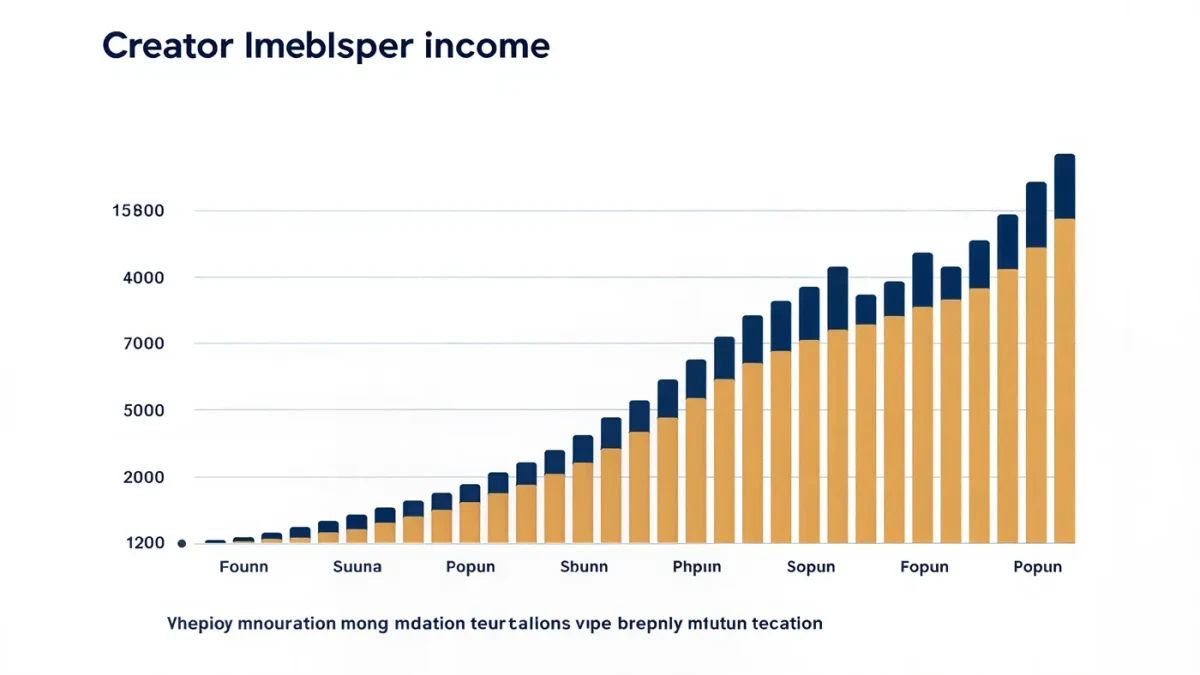
The distribution problem is the decisive one. When a platform says it paid billions to creators in a year, the figure typically spans everyone from celebrities to accounts that received a few dollars, and medians, where platforms disclose them, land far below the mean. A small number of very high earners can make an ecosystem look healthy while the median participant earns close to nothing, which is exactly the pattern in the payout disclosures that YouTube, TikTok, Meta, Snap and X have published in various years since 2021. Any claim about a growing middle class needs a distribution, not a total.
How much do mid-tier creators actually make?
Public evidence points to modest, volatile numbers. Platform ad-share programs generally pay on revenue generated, so a mid-tier video creator' income moves with CPM cycles and algorithm changes rather than with effort. Patreon has said the majority of its payout total goes to a minority of creators, consistent with the skewed distributions elsewhere. Brand-deal marketplaces publish rate cards, but reported deal rates are self-reported asking prices, not transaction records, and surveys from creator-economy vendors consistently show large shares of respondents earning under a threshold that would qualify as part-time income in the United States.
| Income stream | Who discloses data | Reliability for middle-tier claims |
|---|---|---|
| Platform ad revenue share | Platforms' annual creator-payout posts | Totals only; distribution rarely published |
| Brand deals | Vendor surveys, marketplace rate cards | Self-reported, selection bias toward active dealmakers |
| Memberships and subscriptions | Patreon, Substack company statements | Covers platform users only; skew documented |
| Platform creator funds | Platform announcements | Marketing instruments, pools not incomes |
| Bank and analyst estimates | Goldman Sachs, eMarketer | Modeled totals, useful for size not distribution |
Where does a genuine middle tier appear?
The strongest documented case for a middle class is not ad revenue but diversified niches: newsletter writers with paid tiers, educators with course income, B2B creators monetizing an audience of employers rather than eyeballs, and boutique agencies that industrialize production for a handful of clients. In these models, a few thousand true subscribers can sustain a full-time income because the revenue per follower is orders of magnitude higher than ad share. The pattern echoes the direct-patronage economics that Substack and Patreon built their businesses on, and it explains why the middle class grows fastest where audience size matters least.
By contrast, entertainment formats that depend on reach, short-form video in particular, concentrate earnings at the top because the paying counterpart is an advertiser buying scale. TikTok's Creativity Program, introduced in 2023 to replace the original creator fund after widespread creator complaints about low payouts, improved rates for longer videos, but the platform's own payout thresholds still exclude the accounts that most surveys would call lower-middle tier. Reach-based monetization rewards the top of the distribution by construction.
What risks reset creator income year to year?
Three documented forces do the resetting. First, algorithm and format changes reallocate reach, and with it revenue share, without notice. Second, program terms change: platforms from YouTube to TikTok have adjusted eligibility, payout formulas and content requirements across 2022-2025, and each adjustment redistributes income. Third, platform-level policy risk, demonstrated by the US divest-or-ban law aimed at TikTok upheld in January 2025, can threaten an entire distribution overnight. A middle class built on one platform's goodwill is not a middle class in the labor-market sense.
What would better data look like?
The measurement gap has known fixes, which is why its persistence is informative. Platforms could publish payout distributions, medians and eligibility counts rather than aggregate totals; the fact that none did so as of 2025 suggests the distributions are less flattering than the totals. Standard industry definitions separating full-time, part-time and aspirational creators would make vendor surveys comparable, and tax statistics will eventually treat creation as an observable occupation category, as rideshare work became earlier. Until then, analysts should apply one test to every creator-economy number: does it describe dollars, people or a distribution? Dollar totals dominate coverage, while the middle-class question is a question about people and distributions, and the quiet substitution of one for the other is where most creator-economy reporting misleads.
How should marketers and platforms read these numbers?
Marketers should treat "creator" as a segment label with almost no income meaning attached, and evaluate partners on documented reach and past campaign performance instead of aspirational categories. Platforms and vendors citing creator-economy totals should be read the same way sovereign GDP figures are: informative about scale, silent about who captures it. The middle-class framing is useful precisely because it forces the distribution question, and until platforms publish median payouts rather than aggregate ones, the honest answer is that the creator middle class is real in niches and unproven in aggregate.