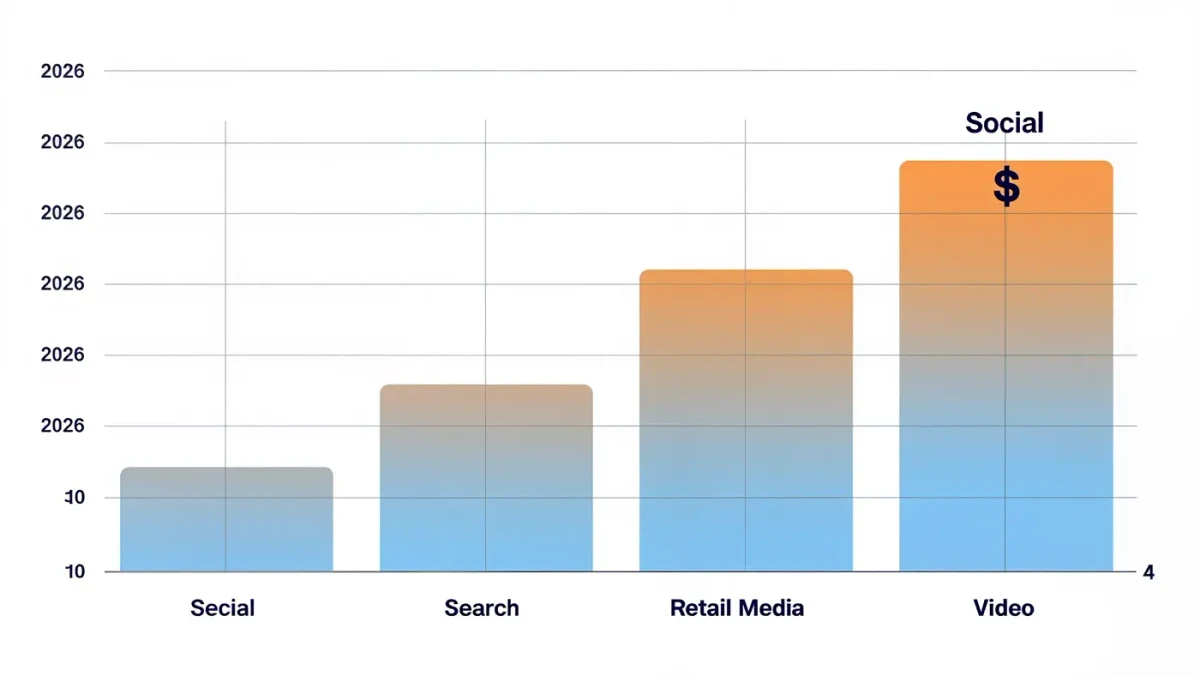
Social media is set to consolidate its position as the world's largest advertising channel in 2026, with WARC Media forecasting social investment to reach $247.3 billion globally within a total ad market it projects at roughly $1.32 trillion, per WARC's December 2025 global ad spend outlook. The forecast, eMarketer's syndication of WARC data confirms, represents the first full planning year in which social outlays exceed every other media channel including paid search and retail media.
What is driving the social ad spend forecast?
WARC's December 2025 outlook put total 2026 ad growth near 9%, continuing a pattern in which the firm's revisions have trended upward, per eMarketer's coverage of WARC's forecasts. Social's share of that growth reflects short-form video CPMs, performance-commerce integration and AI-driven ad delivery concentrating budgets on Meta, TikTok, YouTube and their challengers.
Independent estimates frame the same trajectory from wider definitions: Statista's outlook puts worldwide social media ad spending at $338.75 billion for 2026, counting formats WARC's channel definition treats separately. The gap between the two figures is itself a planning signal — budget benchmarking depends heavily on which formats each forecast counts as social.
Where are the risks to the forecast?
WARC's December outlook carried an explicit caveat that geopolitical disruption — the Gulf crisis and its effect on energy and shipping markets — could put as much as $94 billion of expected ad growth at risk across the forecast horizon. Supply-chain-exposed advertisers are the swing factor: if their budgets contract, social's headline growth rate compresses even if channel mix holds.
Event spend cuts the other way. WARC separately forecasts the FIFA World Cup 2026 injecting roughly $10.5 billion into the ad market, with social platforms capturing a disproportionate share of conversational and short-form amplification around the tournament.
How should media planners use these numbers?
Forecast-level figures are directional, but the composition behind them is actionable. The concentration of social growth in AI-automated ad products means incremental budgets flow disproportionately to platforms where automation is furthest along — Meta's Advantage+ ecosystem and TikTok's Smart performance campaigns — which in turn raises the internal capability bar for advertisers.
The planning implication for the rest of 2026: brands that set social targets against the WARC channel definition rather than vendor-defined benchmarks will find their share-of-wallet math more defensible in CFO conversations, and locking World Cup-window inventory early is the single clearest near-term arbitrage the forecast identifies. The numbers say social is no longer a line item to justify — it is the base against which every other channel now gets compared.