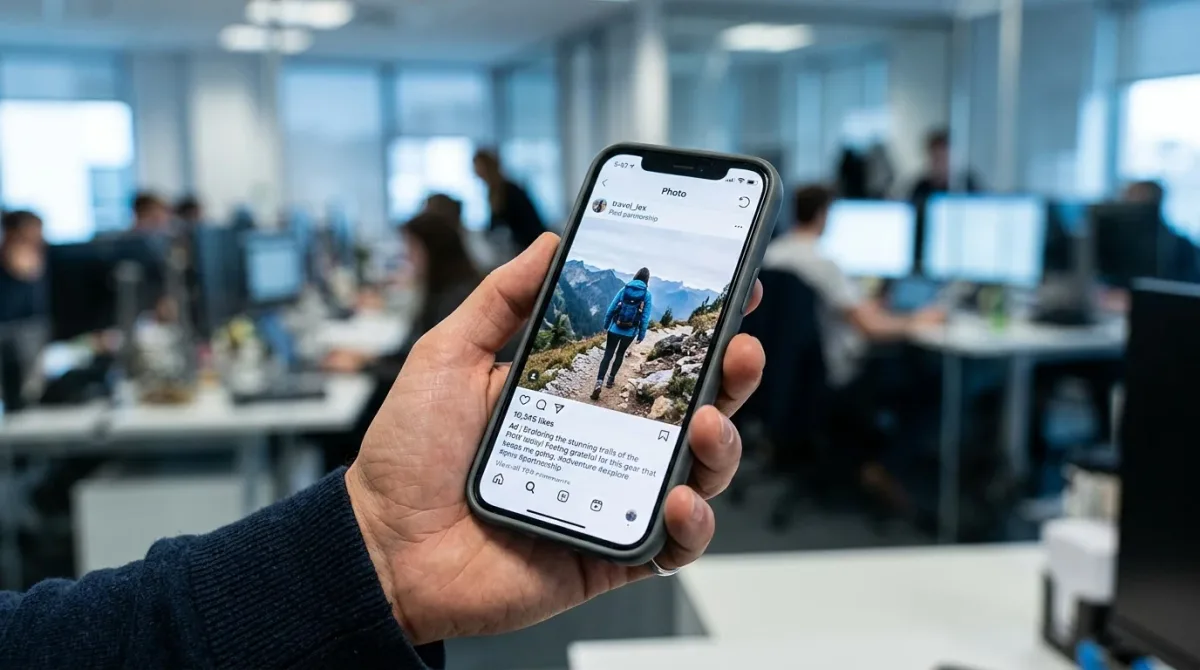
The Federal Trade Commission holds brands, not just the influencers they pay, legally responsible for undisclosed paid endorsements on social media, under the Endorsement Guides the agency finalized in a unanimous 3-0 vote on June 29, 2023. A brand cannot outsource compliance to an influencer, an agency, or a platform's own disclosure tools.
Who is legally responsible when a sponsored post skips the disclosure?
The brand is, according to the FTC, even when the post itself is written and published by an independent creator. The agency's guidance states plainly that "your company is ultimately responsible for what others do on your behalf," a standard that covers influencers, talent agencies, and any intermediary hired to recruit them.
That liability does not require a company to police every post in real time. It does require a training and monitoring program scaled to the risk of the campaign: written instructions on what claims an endorser can make, explicit wording requirements for disclosures, periodic searches for what network members are actually posting, and follow-up when a post falls short. The FTC has said pre-approval of draft posts is more workable for most programs than trying to catch problems after publication.
What changed in the FTC's 2023 update to the Endorsement Guides?
The commission's 2023 revision to the guides, first issued in 1980 and periodically updated since, broadened the definition of "endorsement" to explicitly reach fake and manipulated reviews, virtual and AI-generated influencers, and platform features such as tags. It also added a formal definition of what counts as a "clear and conspicuous" disclosure and flagged that a platform's own built-in disclosure label is not automatically sufficient to satisfy it.
The update, approved by all three sitting commissioners, also addressed incentivized reviews — including employee endorsements and compensated testimonials — and clarified where liability can extend to advertisers, endorsers, and the intermediaries who connect them. It named child-directed advertising as an area of particular concern. Alongside the revised guides, the FTC published an expanded question-and-answer resource covering roughly 40 additional scenarios raised by advertisers and platforms.
Can brand teams rely on Instagram's or TikTok's paid-partnership label alone?
No. The FTC's own guidance is explicit that "the ultimate responsibility for clearly and conspicuously disclosing a material connection rests with the influencer and the brand — not the platform," regardless of whether a built-in tag such as a paid-partnership label is also in use.
The agency evaluates three factors when a disclosure's adequacy is in question: placement, meaning whether it appears where a viewer's attention would naturally fall rather than buried in a bio or behind a "more" link; readability, meaning legible type against a contrasting background held on screen long enough to register; and clarity, meaning unambiguous wording. A generic label reading "contains paid content" can fail that third test if a post features several products and it is unclear which one the payment relates to. Brand teams that treat a platform's automated tag as the entire compliance step, rather than one layer of it, are working from an assumption the FTC has directly rejected.
What disclosure wording does the FTC treat as adequate for affiliate links?
The agency's guidance draws a specific line between wording it considers clear and wording it considers ambiguous, particularly for affiliate and commission-based links common in shopping and creator content.
| Disclosure wording | FTC assessment |
|---|---|
| "I get commissions for purchases made through links in this post" | Adequate |
| "Paid link" placed directly next to the link itself | Adequate |
| "Affiliate link" used alone, with no further explanation | Insufficient — meaning is unclear to a general audience |
| "Commissionable link" | Insufficient — ambiguous phrasing |
| Hashtag abbreviations such as "sp" or "spon" standing alone | Insufficient |
Placement matters as much as wording: the guidance calls for the disclosure to sit as close as possible to the link or claim it modifies, with a single disclosure sufficient only when the product mention and the link are visible to the viewer at the same time.
Does the rule change once a brand reposts or pays to boost a creator's content?
The FTC's published materials do not lay out a dedicated rule for reposted or boosted influencer content, but the underlying principle carries over directly: if the paid promotion strips away context a viewer would otherwise have had — such as the original caption or the account's history with the brand — the disclosure has to travel with the repost, not just the original post.
The same logic applies to purchased engagement. The FTC's guidance distinguishes between a brand offering incentives for likes or reviews from real customers, which it treats as a disclosure question, and a brand or influencer buying fake likes or followers from accounts that do not represent real people, which the agency says can expose both the buyer and the seller to enforcement action in its own right, independent of any disclosure failure.
What does a defensible influencer-monitoring program include?
- Written instructions to endorsers on what product claims are and are not permitted.
- Specific, approved disclosure language rather than a general instruction to "disclose appropriately."
- A pre-publication review step for sponsored posts where campaign risk warrants it.
- Periodic searches of what network members are actually posting, not just what was approved in a brief.
- A documented response when a post is found to be missing a required disclosure.
None of these steps guarantees a program clears FTC review; the agency has said it does not expect a brand to catch every statement made by every network participant, only to make a reasonable, risk-scaled effort. What the guidance does foreclose is the more common shortcut — treating disclosure as solely the influencer's problem, or as fully handled once a platform's tagging feature is switched on.
Frequently asked questions
- Does an agency that recruits influencers on a brand's behalf carry its own liability? Yes. The FTC's guidance states that agencies and other intermediaries can face liability if they help create or spread endorsements they know or should know are deceptive, or that lack a required disclosure.
- Is a hashtag like #collab or #sp treated as an adequate disclosure on its own? No. The FTC's guidance singles out vague, standalone abbreviations such as "sp," "spon," or "collab" as inadequate, since a general audience is unlikely to understand them as a paid-relationship disclosure.
- Do video and livestream disclosures need to be repeated, or is one mention enough? The FTC's guidance calls for disclosures in video to appear in both the audio and the visual track where practical, and for livestreams specifically recommends repeating the disclosure periodically so viewers who join mid-stream still see it.
- Can a brand be penalized for an influencer's fake followers even without a disclosure issue? Potentially, yes. The FTC treats the purchase of fake likes or followers from non-existent accounts as a distinct issue from disclosure, one that can expose both the buyer and the seller of the fake engagement to enforcement action.
For a related trends perspective, read Paid Social Teams Blend Brand Lift, MMM, and Pixels Over Last-Touch Attribution.